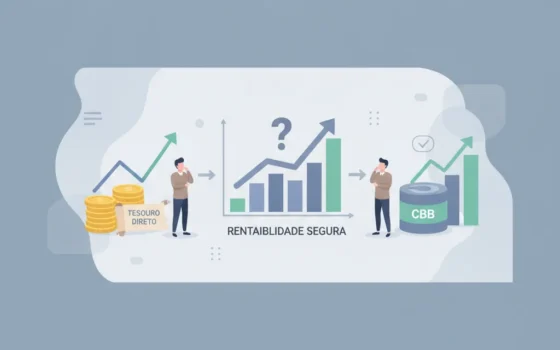
Understanding the best forms of safe investment is essential for anyone seeking to grow their wealth with peace of mind. Two popular options are the Tesouro Direto and the CDB, which attract investors because they are considered low-risk alternatives. With this in mind, let's compare Tesouro Direto and CDB to help you choose which one offers better safe returns.
What Tesouro Direto and CDB are and how they work
Tesouro Direto is a federal government program that allows you to buy public bonds over the internet. You lend money to the government and receive interest in return, paid at maturity or periodically. It is considered a safe investment because the risk of default by the Brazilian government is low.
On the other hand, the CDB (Certificado de Depósito Bancário, or Bank Deposit Certificate) is a fixed-income security issued by banks to raise funds. You lend money to the bank and receive interest, which can be prefixed, post-fixed, or linked to inflation. Safety depends on the issuing bank, but CDBs are guaranteed by the Credit Guarantee Fund (FGC) up to R$ 250 thousand per individual taxpayer ID (CPF) and per institution.
Advantages and benefits of Tesouro Direto and CDB
Tesouro Direto offers daily liquidity on specific bonds, which makes it possible to redeem your money before the deadline, usually at low cost. It also allows you to invest small amounts, and taxes are progressive depending on the term. Bonds linked to inflation help protect your money from losing purchasing power.
CDBs, issued by various banks and finance companies, can offer higher returns depending on the issuer and the type of security. Some CDBs pay an above-average percentage of the CDI, which can yield more attractive returns for certain terms. The FGC guarantee provides important security for the investor, especially at smaller banks.
Precautions and points of attention for investing safely
With Tesouro Direto, the main precaution is understanding that bond prices fluctuate with interest rates. If you need to sell before maturity, you may incur losses. Additionally, taxation, although progressive, must be considered when calculating the net return.
For CDBs, it is important to check the soundness of the issuing bank and the FGC coverage, since amounts above R$ 250 thousand are not guaranteed. Another point is the grace period or redemption term, which can vary and affect liquidity, unlike some public bonds that offer easy sale.
How to apply and start investing in Tesouro Direto and CDB
To invest in Tesouro Direto, simply open an account with an authorized brokerage, such as XP, Rico, or Ágora, all integrated with the system. After registering, you can invest minimum amounts starting from around R$ 30, choosing among the different public bonds available.
To invest in CDBs, you can look at digital banks such as Inter, Next, and Neon, or finance companies such as PAN and BMG, which offer options with good return rates. The application can be made online, directly through the bank or brokerage, and in many cases the minimum amount is affordable, making it easy to get started.
Conclusion
Deciding between Tesouro Direto and CDB depends on the investor's profile and financial goal. Tesouro Direto is ideal for those seeking total safety and daily liquidity on some bonds, as well as protection against inflation. CDBs can offer better returns for specific terms, especially when issued by smaller banks, provided the FGC guarantee is respected.
Both options are safe when considered with attention to the precautions mentioned. Evaluating the term, liquidity, rate, and issuer risk will help you choose the investment that best fits your financial planning.