Introduction
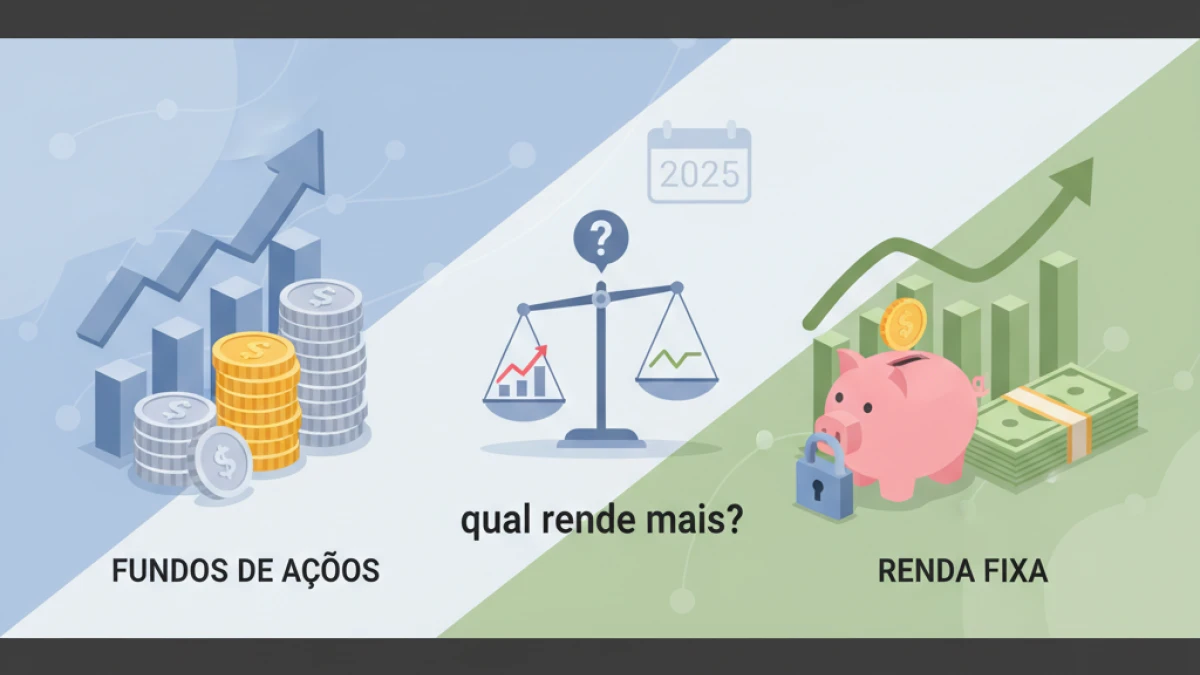
Equity funds and fixed income funds are two of the most sought-after investment options in the Brazilian financial market. In 2025, the question of which of these funds offers better returns stands out for investors seeking to balance risk and return. Understanding the characteristics, trends and performance of each type is essential for making informed decisions, especially in an economic scenario that alternates between volatility and stability.
Understanding Equity and Fixed Income Funds
Equity funds mainly invest in shares of companies listed on the stock exchange, which offers the potential for higher gains with greater volatility. Meanwhile, fixed income funds invest in public or private bonds with prefixed, post-fixed or index-linked returns, seeking greater safety and predictability.
Characteristics of Equity Funds
- Greater long-term appreciation potential;
- Higher risk, subject to market fluctuations;
- Suited to investors with a more aggressive profile;
- Returns depend on the performance of companies and the economy;
Characteristics of Fixed Income Funds
- More stable and predictable returns;
- Lower risk compared to equity funds;
- Suited to conservative investors;
- Returns impacted by factors such as the Selic rate and inflation;
Fund Performance in 2025
In 2025, the Brazilian economic scenario shows some trends that influence the performance of equity and fixed income funds:
- Selic rate slightly rising, favoring fixed income funds that track the basic interest rate;
- Gradual improvement in economic activity, boosting the stock market;
- Controlled inflation, which maintains the purchasing power of fixed income investments;
- International volatility remains high, affecting emerging markets.
According to data released by institutions such as the Central Bank of Brazil and recent economic reports, fixed income funds that track the Selic have shown average returns close to 12% per year in 2025. Meanwhile, equity funds have varied between gains of 8% and 18%, depending on the sector and strategy adopted.
Comparison between Equity and Fixed Income Funds
| Aspect | Equity Funds | Fixed Income Funds |
|---|---|---|
| Risk | High | Low to medium |
| Return Potential | High | Moderate |
| Liquidity | Medium to high | High |
| Investor profile | Aggressive | Conservative to moderate |
| Selic impact | Indirect | Direct |
How to Choose the Best Fund for You?
When deciding between equity or fixed income funds, besides historical returns, it is important to consider:
- Personal risk profile: assess your tolerance for declines and volatility.
- Financial goals: short-term investments tend to favor fixed income, while the long term can take advantage of stocks.
- Diversification: combining funds can balance risks and gains.
- Fees and costs involved: administration and performance fees impact net returns.
Institutions such as Banco Inter and Santander offer platforms that make detailed analysis easier to help investors choose funds according to their profile and goals.
Conclusion: Which Fund Yields More in 2025?
In 2025, there is no single answer to which fund yields more, as performance depends on the scenario and the investor's profile. Fixed income funds have shown stability and good returns due to the higher Selic, making them more suitable for those who prioritize safety. Meanwhile, equity funds offer potential for greater gains, but with higher volatility, attracting investors willing to take on more risk.
For a balanced strategy, many professionals recommend diversifying the portfolio between both, taking advantage of the benefits of each type. In addition, following economic updates and relying on specialized advice can optimize your results.
Want to start investing or adjust your portfolio? Research the options available on platforms such as BTG Pactual, Avenue or Mercado Pago and use digital tools to monitor your investments conveniently.