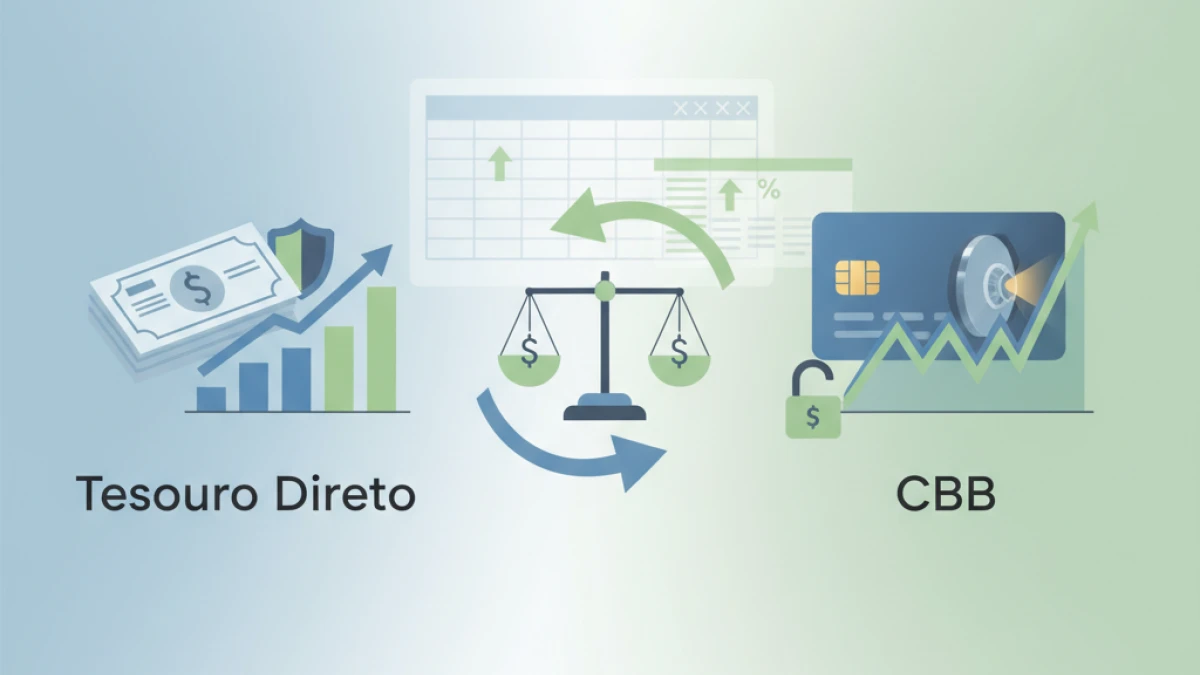
If you're thinking about investing, you may be wondering: Tesouro Direto or CDB? Which investment currently offers the better return? Understanding the differences between these two investments is essential for making a smart choice. Each option has specific characteristics that directly affect profitability and risk.
What it is / How it works
Tesouro Direto is a government program that allows you to buy public bonds over the internet. These bonds are a way for the government to raise funds to finance its activities. When you buy a Treasury bond, you are lending money and, in return, receive interest that can be fixed, tied to inflation, or linked to the Selic rate.
CDB (Bank Deposit Certificate), on the other hand, is a security issued by banks to raise funds. It works like a loan the investor makes to the financial institution. In return, the bank offers a remuneration, which can be pre-fixed, post-fixed, or hybrid, usually related to the CDI (Interbank Deposit Certificate).
Advantages and benefits
Tesouro Direto has the advantage of security, as it is guaranteed by the National Treasury, one of the most solid institutions in the country. In addition, it can be accessed with small amounts and offers a variety of bonds for different goals and maturities. Another benefit is daily liquidity, which allows you to sell your bonds at any time.
CDBs, in turn, tend to offer more attractive returns, especially when issued by mid-sized banks and fintechs such as Inter and Banco PAN. Some CDBs offer higher returns than Tesouro Direto, especially if they are pre-fixed or post-fixed with a higher percentage of the CDI. They are also protected by the FGC (Credit Guarantee Fund) up to certain limits, providing security for the investor.
Precautions and points of attention
When choosing Tesouro Direto, the investor should pay attention to taxes, such as Income Tax, which varies according to the investment term. Also, the return is not guaranteed if the bond is sold before maturity, due to market fluctuations.
For CDBs, it is essential to check the rating of the issuing bank, since credit risk directly influences the safety of the investment. It is also important to observe the term and liquidity, as some CDBs require the money to stay invested until maturity to avoid loss of return or even devaluation. The investor should check whether the security is post-fixed, pre-fixed, or hybrid, since this affects the final yield.
How to apply / get started
To invest in Tesouro Direto, you need to open an account with a brokerage such as XP, Rico, or Modal. Once the account is active, you can access the Tesouro Direto platform and choose the bond best suited to your profile. The entire process is online and simple.
For CDBs, the procedure is similar. Digital banks such as Neon, Next, and PicPay often offer CDB options directly through their apps. It is also possible to buy CDBs through brokerages. It is important to compare rates and offers to find the best available return.
Conclusion
Between Tesouro Direto and CDB, the choice depends on your profile, goals, and risk tolerance. Tesouro Direto is a good option for those seeking security and liquidity, while CDBs can offer higher yields, especially at mid-sized banks or fintechs, but with possible liquidity restrictions. Assess your needs and risks before deciding, and remember that diversifying investments can be a smart strategy to balance returns and security.