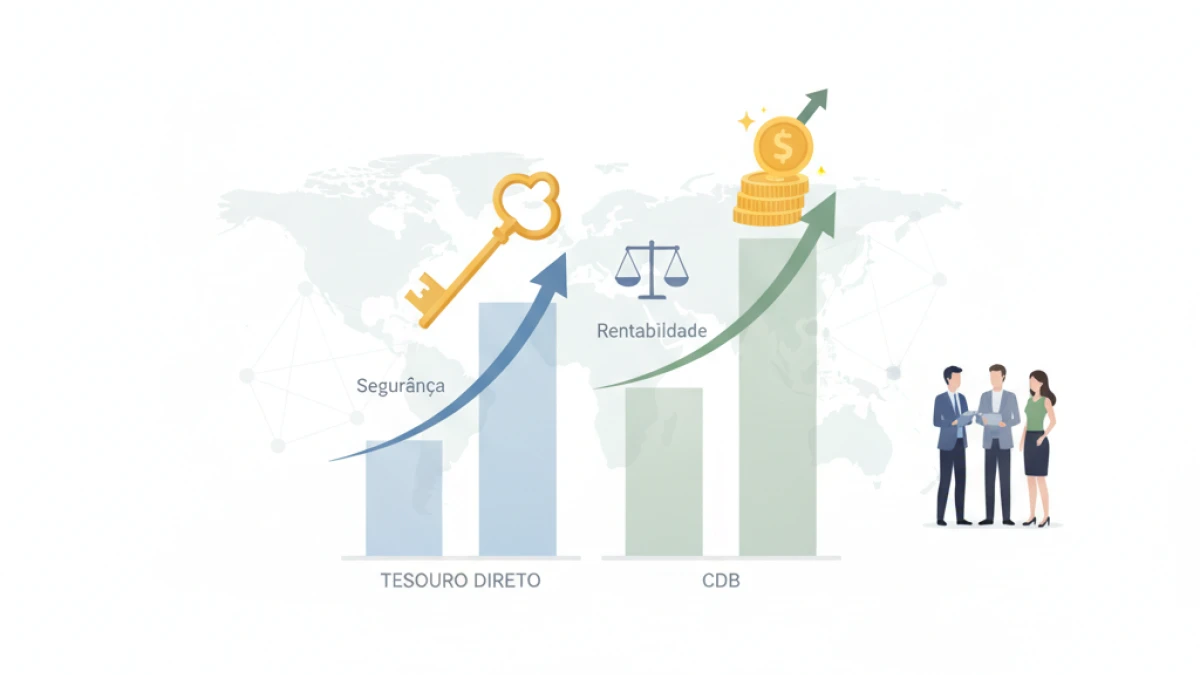
If you are torn between investing in Tesouro Direto or CDB, this article is for you. The pursuit of the highest returns and security leads many investors to wonder which of these options is better. Let's understand the characteristics of each one to help with your decision.
What it is / How it works
Tesouro Direto is a federal government program that allows individuals to buy government bonds. These bonds are a way of lending money to the government in exchange for interest. The investor buys a bond and receives returns, which depend on the type chosen.
On the other hand, the CDB (Bank Deposit Certificate) is a fixed-income security issued by banks to raise funds. The investor lends money to the financial institution and receives the interest offered, which can be pre-fixed, post-fixed, or linked to inflation.
Advantages and benefits
Tesouro Direto offers high security due to the federal government's guarantee. In addition, it is possible to invest with affordable amounts and choose different types of bonds according to the investor's profile. Another advantage is daily liquidity on many bonds, which makes quick redemptions easier.
On the other hand, CDB can offer more attractive returns, especially at smaller banks or fintechs such as Inter, PagBank, or Banco Original, which offer competitive rates to attract investors. In addition, CDB is covered by the FGC (Credit Guarantee Fund) up to a limit, providing protection to the investor.
Precautions and points of attention
It is important to analyze the investment term, since both in Tesouro Direto and CDB, early redemption may have different conditions, such as daily liquidity or a grace period. In the Treasury, daily price variation of the bonds can cause fluctuations.
As for CDB, the risk is tied to the issuing institution. Smaller banks may offer better rates, but it is necessary to assess the bank's soundness and the FGC limit, which generally guarantees up to R$ 250 thousand per CPF per institution.
How to apply / get started
To invest in Tesouro Direto, you need to open an account with a brokerage or bank that offers this option, such as XP, Rico, or Modal. Today, several digital banks such as Next and Nubank also allow investing. After opening the account, simply transfer the money and buy the desired bonds through the website or app.
As for investing in CDB, the process is simple: open an account at a bank or fintech that offers CDB, such as Banco Inter, PicPay, or Will Bank. Evaluate the available rates and terms and invest directly through the institution's digital platform.
Conclusion
To choose between Tesouro Direto or CDB, consider your profile, goals, and preference for security or returns. The Treasury is ideal for those seeking security and guaranteed liquidity, while CDB can be more advantageous for those wanting better returns, as long as they assess the risks. Evaluating different institutions, such as Safra, BTG Pactual, or Sicoob, helps diversify and find the best options.
Understanding these differences is the first step for you to invest with confidence and achieve your financial goals.