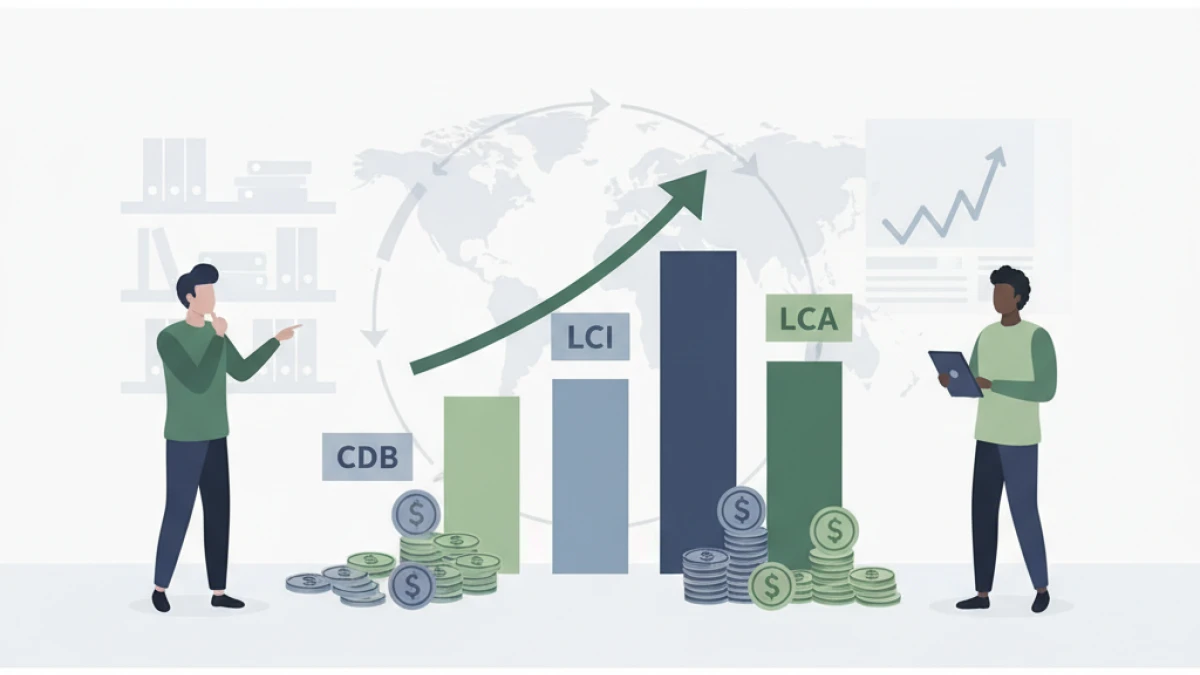
Investing is an important step for anyone who wants to secure a safer financial future. If you're just starting out, you may wonder what the differences between CDB, LCI and LCA are for diversifying your investments and making your money grow better. These three types of investment are common options for those seeking safety and returns at banks and fintechs.
What it is / How it works
CDB (Bank Deposit Certificate) is a security issued by banks to raise money from investors. You lend your money to the bank and, in return, receive earnings on a set date. It can have a prefixed, post-fixed or inflation-linked yield.
LCI (Real Estate Credit Bill)
LCA (Agribusiness Credit Bill)
Advantages and benefits
The main advantage of the CDB is the variety of terms and returns. It is possible to find CDBs with daily liquidity or with maturities ranging from months to years. In addition, CDBs are guaranteed by the Credit Guarantee Fund (FGC) up to a limit, which gives investors security.
LCIs and LCAs have as their main benefit exemption from income tax, which boosts the net return. They are also protected by the FGC, generally with minimum terms that vary according to the financial institution.
Another advantage of these investments is the possibility of diversification. Investing in CDBs, LCIs and LCAs allows you to balance returns, liquidity and security in a personalized way.
Precautions and points of attention
Before investing, carefully analyze the term of the security and your need for liquidity. CDBs with daily liquidity are options for those who want to keep their money available, but they usually offer lower returns. LCIs and LCAs tend to have longer minimum terms, which means you cannot withdraw your money immediately without losing returns.
Also check the reputation and soundness of the bank or fintech issuing the security. Although the FGC protects up to a limit, it is important to choose trustworthy institutions to reduce risks.
Read the investment conditions carefully, such as administration fees, the possibility of early redemption and how returns are paid, so you can make a safe decision aligned with your goals.
How to apply / get started
To start investing in CDB, LCI or LCA, you must open an account with a financial institution that offers these products. Traditional banks such as Santander, Banco do Brasil and Itaú have several options, as do fintechs such as Inter, Neon and Will Bank, which make access easier via cell phone.
After registering, choose the investment that best fits your profile and goals. Compare the return, term and liquidity of the available securities. You can make the investment directly through the app or internet banking.
Although the process is simple, it is essential to monitor your investments regularly to make sure they are performing as expected and to adjust your portfolio as needed.
Conclusion
Understanding the differences between CDB, LCI and LCA is essential for diversifying your investments safely and efficiently. Each of these products has its own characteristics that suit different profiles and needs.
Use the variety of options to build a balanced portfolio, taking advantage of the returns, the security of the FGC and the tax benefits. Choose trustworthy institutions and keep track of your investments to get the best results.
This way, you will be on the right path to achieving your financial goals in a solid and peaceful way.